1954 First mass inoculation against polio with the Jonas Salk vaccine takes place at Arsenal Elementary School in Pittsburgh, Pennsylvania.
In the United States, a major outbreak of polio occurred in 1952. During that year, the disease infected around 57,000 people, killed over 3,000 and left some 20,000 with mild or debilitating paralysis. It was the last great outbreak of this disease, once one of the most feared diseases in the world.
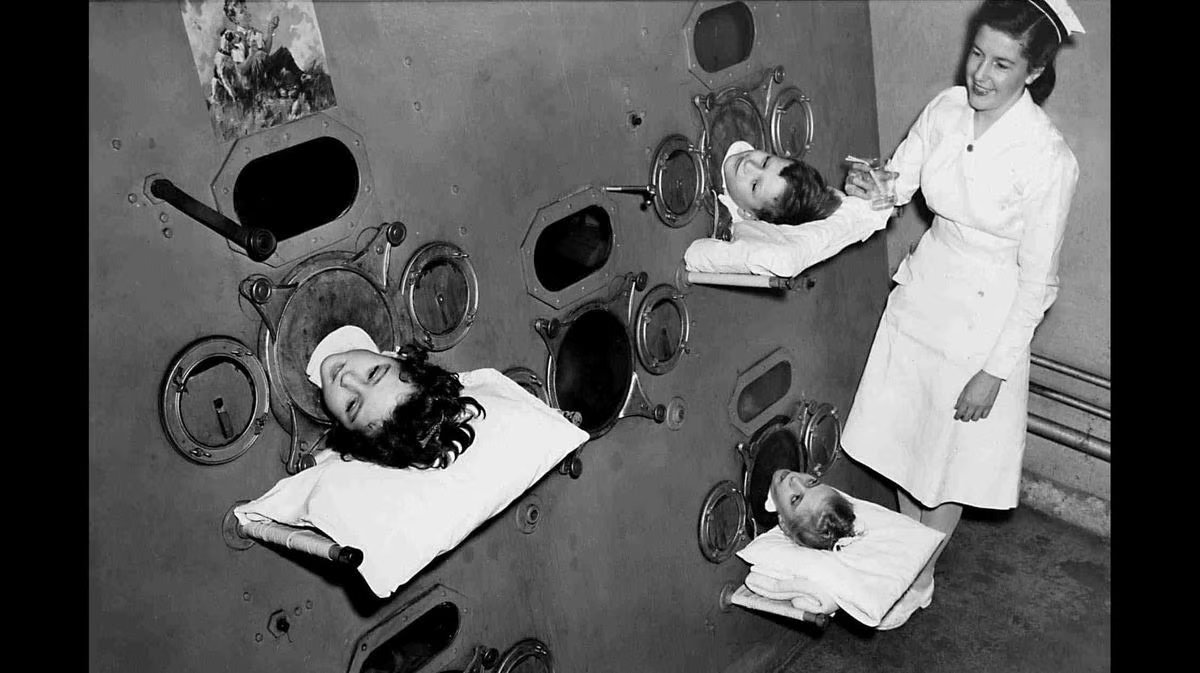
Polio would often strike without warning. In most cases, around 75%, there were no symptoms at all, but in 0.1-0.5% of infections the patient would suffer from mild or debilitating paralysis. This would often lead to deformities in the limbs for the rest of the patient’s life. In some cases, the muscles of the neck and diaphragm would be paralyzed, meaning the patient would struggle to breath on their own. In the early days, this required the use of an ‘iron lung’, a large negative-pressure chamber that breathed for the patient as they lay inside.
Most would be in the lung for a few weeks or a month while they were treated. A few unlucky cases would require the lung for the rest of their lives; as of 2013, there were estimated to be six to eight iron lung users, some of whom can only leave for hours at a time before they struggle to breath.
A number of famous people had polio, including singer Neil Young, Nazi Joseph Goebbels and possibly US President Franklin D. Roosevelt (he used a wheelchair for the rest of his life, but it is believed the disease could have been Guillain–Barré syndrome).
On April 12, 1955, scientist Jonas Salk announced the first successful polio vaccine, which was rapidly adopted around the world. When the news was announced, Salk was greeted as a hero, and some members of Congress even called for the day to be a national holiday.
Today polio is extremely rare. In 2019 there were 175 cases of wild polio and 364 cases of vaccine-derived polio; only Afghanistan and Pakistan reported cases of the wild disease.